
Mason jars aren’t just for homemade jams anymore—they’ve become essential for food storage, packaging, and décor. Whether you’re a home canner or a business selling sauces or candles, understanding mason jar sizes ensures the right balance of functionality and presentation. This guide breaks down every jar dimension, mouth type, and lid finish, so you can make informed choices for personal, professional, or commercial use.
Anatomy of a Mason Jar
A mason jar has three main parts: the body, mouth, and lid. The body styles vary—smooth, embossed, or straight-sided—each influencing labeling and storage. Mouth types include regular-mouth (70 mm) and wide-mouth (86 mm) jars, while some commercial jars use special finishes (89-400, 110-400). The lids can be two-piece canning lids, single metal caps, or specialty lids like pump, straw, or shaker tops.
Comprehensive Mason Jar Size Chart
Here’s an overview of standard mason jar sizes with U.S. and metric equivalents:
| Jar Size | Ounces (oz) | Milliliters (ml) | Mouth Type | Height | |
|---|---|---|---|---|---|
| 4 oz | 118 ml | Regular | ~2.5 in | Jams, spices, samples | |
| 8 oz (Half Pint) | 236 ml | Regular/Wide | ~3.9 in | Candles, sauces | |
| 12 oz | 355 ml | Regular | ~4.5 in | Yogurt, salads | |
| 16 oz (Pint) | 473 ml | Regular/Wide | ~5.2 in | Smoothies, oats | |
| 24 oz | 710 ml | Wide | ~6 in | Layered salads, grains | |
| 32 oz (Quart) | 946 ml | Wide | ~6.9 in | Pickles, fermentation | |
| 64 oz (Half Gallon) | 1.9 L | Wide | ~9 in | Bulk storage, beverages |
Comparing Mason Jar Sizes
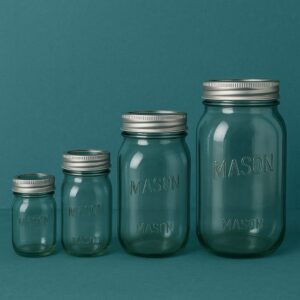
Visualizing jar sizes helps you choose correctly. 4 oz jars are palm-sized, while 8 oz jars hold a single serving. The 16 oz pint fits two cups, and the 32 oz quart equals four cups. Remember, wide-mouth jars are easier to fill and clean, whereas regular-mouth jars are perfect for pouring liquids. Use smaller jars for jams or dressings and larger ones for bulk storage or canning.
Choosing by Application
- Canning & Preservation: Use 8–16 oz jars for jams, fruits, and sauces. Always leave ½-inch headspace.
- Freezer Storage: Pick straight-sided jars to avoid cracking during expansion.
- Fermentation: 32 oz or 64 oz jars are ideal for kimchi, kombucha, or sauerkraut.
- Packaging & Retail: Choose jars with smooth sides for easy labeling and consistent branding.
- Crafts & Décor: Mini jars are great for gifts, candles, and wedding favors.
Temperature, Pressure & Safety Ratings
Not every glass jar is made for canning. Look for Ball or Kerr jars labeled “for preserving” — they withstand boiling and pressure-canning temperatures. Avoid reusing store-bought jars for canning; they may crack. For freezing, only use straight-sided mason jars and leave headspace. Never pour boiling liquids into cold jars. For pressure canning, select jars that meet USDA/NCHFP safety standards to prevent breakage and contamination.
Material Innovation & Sustainability
Modern mason jars have evolved with sustainability in mind. Some brands now use recycled glass, BPA-free lids, or stainless-steel caps. Weck jars use reusable rubber gaskets and glass lids for zero waste. For eco-conscious consumers, recyclable packaging and compostable lids offer greener options. Compared to plastic containers, glass mason jars are non-toxic, odor-free, and can last decades when cared for properly.
Commercial Use & Wholesale Buying Guide
For businesses, knowing neck finish sizes like 70-450 or 89-400 ensures lid compatibility. Bulk buyers should check MOQ (Minimum Order Quantity) and packaging options like cases of 12 or pallet shipments. Opt for clear glass jars for retail visibility or amber jars for UV protection. Wholesale suppliers often offer custom labeling and embossing for branding. Buying in bulk can reduce per-unit cost significantly for small producers.
Brand Comparison
| Brand | Origin | Highlights | Best For |
|---|---|---|---|
| Ball | USA | Reliable, thick glass, affordable | Home canning |
| Kerr | USA | Interchangeable lids with Ball | General use |
| Weck | Germany | Glass lids, rubber seals, eco-friendly | Sustainable storage |
| Le Parfait | France | Premium, airtight clip-top | Professional kitchens |
| Anchor Hocking | USA | Heavy-duty, durable | Commercial packaging |
Metric Conversion & International Use
Mason jar sizing differs globally. In the U.S., jars are measured in fluid ounces, while most countries use milliliters or liters. Here’s a quick conversion:
- 4 oz = 118 ml
- 8 oz = 236 ml
- 16 oz = 473 ml
- 32 oz = 946 ml
- 64 oz = 1.9 L
Always include both units in your product descriptions or recipes if targeting an international audience.
Common Mistakes & Myths
- Myth: “All lids fit all jars.”
Truth: Each jar size has its matching lid diameter. - Myth: “Any jar is freezer-safe.”
Truth: Only straight-sided jars are recommended for freezing. - Myth: “Bigger jars are better for everything.”
Truth: Smaller jars maintain freshness and reduce waste. - Myth: “You can reuse canning lids indefinitely.”
Truth: Reused lids may fail to seal properly.
FAQs — Quick Answers
Q1: Can I reuse lids?
A: Only if they’re designed for multiple uses, like Weck or BPA-free silicone lids.
Q2: What’s the best jar for candle making?
A: 8 oz or 12 oz jars with wide mouths and smooth sides.
Q3: Are mason jars microwave-safe?
A: The glass is safe, but avoid heating metal lids or seals.
Q4: Can I pressure-can with any glass jar?
A: No. Use Ball or Kerr jars rated for canning pressure and heat.
Conclusion — Find the Perfect Mason Jar for Your Needs
Whether you’re storing pantry staples, packaging homemade goods, or creating unique crafts, choosing the right mason jar size ensures function and flair. Match your mouth type, capacity, and lid finish for safety and style. With this guide, you can pick jars that fit your project—whether that’s a 4 oz spice jar or a 64 oz fermentation vessel—knowing they’ll perform beautifully every time.